
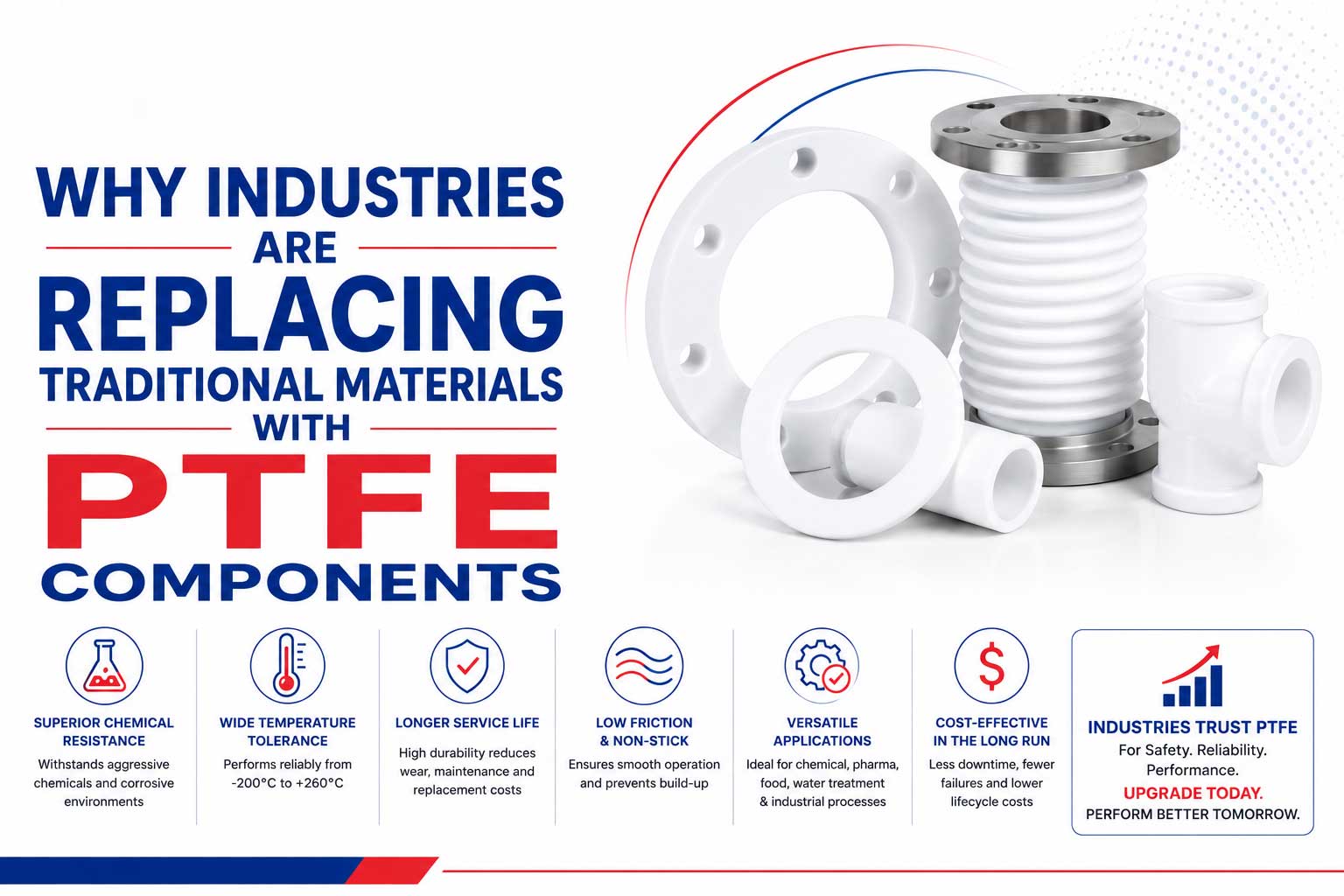
Why Industries Are Replacing Traditional Materials with PTFE Components — The Complete 2026 Guide
There is a moment that nearly every process engineer in the chemical, pharmaceutical, or oil and gas industry has lived through. A gasket fails. A valve seat corrodes. A bush seizes under chemical exposure. Production stops. And somewhere in the post-incident review, someone asks the question that should have been asked at the design stage: "Why weren't we using PTFE?"
Polytetrafluoroethylene — PTFE — is one of the most extraordinary engineering materials ever developed. Its combination of near-total chemical inertness, an operating temperature range from -200°C to +260°C, one of the lowest coefficients of friction of any solid, outstanding electrical insulation, and zero biological reactivity makes it the material of choice across the world's most demanding industrial environments. Fluoro Polymer Products, established in Anand, Gujarat in 1992 and ISO 9001:2015 certified by TUV Nord, has spent over 30 years engineering precision PTFE components for these industries.
Core Properties That Make PTFE Exceptional
| Property | PTFE Performance | Industrial Significance |
|---|---|---|
| Chemical Resistance | Resistant to virtually all chemicals | Safe contact with corrosive acids, alkalis & solvents |
| Operating Temperature | -200°C to +260°C | Cryogenic and high-heat applications |
| Coefficient of Friction | 0.05–0.10 (among lowest known) | Exceptional bearing and sealing performance |
| Dielectric Strength | Very high | Electrical insulation in HV/MV switchgear |
| Water Absorption | < 0.01% | Dimensionally stable in wet environments |
| Biological Inertness | Fully inert | Safe for pharmaceutical and food contact |
Why Traditional Materials Fail Where PTFE Succeeds
PTFE vs Rubber Seals and Gaskets: Rubber gaskets — whether EPDM, NBR, or neoprene — degrade, swell, harden, or crack in the presence of strong acids, oxidising chemicals, hydrocarbons, or at elevated temperatures. In chemical processing plants where the process fluid is aggressive, rubber failure is a matter of when, not if. PTFE gaskets maintain integrity in the same environments for years — with no risk of chemical extraction or process contamination.
PTFE vs Stainless Steel: Even premium alloys are susceptible to chloride stress corrosion cracking, pitting in halide environments, and attack by strong reducing acids like hydrofluoric acid. PTFE is immune to all of these failure modes. For components in direct contact with corrosive process fluids — gaskets, liners, valve seats, bushes — PTFE provides a longer-lasting, more reliable, and often more cost-effective solution.
PTFE vs Ceramic and Glass-Lined Components: Ceramic and glass-lined components are inherently brittle and vulnerable to thermal shock and mechanical impact. PTFE components combine chemical resistance with mechanical resilience and flexibility — significantly more robust against the real-world stresses of continuous industrial operation.
The 8 Industries That Rely on PTFE Components
1. Chemical Processing: PTFE gaskets, bellows, valve seats, and lined pipe components provide reliable chemically inert containment across the full spectrum of aggressive chemical applications — sulphuric, hydrochloric, nitric, hydrofluoric acids, organic acids, and oxidising agents.
2. Pharmaceutical Manufacturing: PTFE meets USP Class VI and FDA 21 CFR requirements for direct product contact. PTFE gaskets, valve seats, seals, and tube components are standard across API manufacturing, formulation, and packaging lines.
3. Oil and Gas: PTFE valve seats, seals, backup rings, and packing components provide reliable performance in high-pressure, high-temperature, sour gas (H₂S) service — where many metallic and elastomeric materials are rapidly degraded.
4. Power Generation: PTFE's dielectric properties and chemical resistance make it particularly valuable in power generation environments where both electrical isolation and chemical containment are critical.
5. Glass-Lined Reactor Systems: PTFE bushes, manhole seals, nozzle liners, and valve seat components protect the fragile glass lining while providing full chemical resistance — the universal specification for glass-lined vessel connections.
6. Electrical Industry (HV/MV Equipment): PTFE nozzles and collar bushes in high-voltage and medium-voltage circuit breakers are precision-engineered to exacting tolerances that directly affect safe fault current interruption.
7. Food Processing: FDA-compliant for food contact, resistant to CIP/SIP cleaning chemicals — PTFE is the standard for seals, gaskets, and conveying components in food processing plants.
8. Petrochemical Industry: PTFE components across distillation, cracking, and reforming processes provide the combination of chemical and thermal resistance that no alternative material can match.
Understanding PTFE Grades — Choosing the Right One
| Grade | Key Properties | Best Applications |
|---|---|---|
| Virgin / Pure PTFE | Maximum chemical resistance, FDA-compliant | Pharma, food, highest-purity chemical |
| Glass-Filled PTFE | Improved creep resistance, higher load capacity | High-load sealing, static gaskets |
| Carbon-Filled PTFE | Improved wear resistance, electrical conductivity | Dynamic seals, bearings, bushes |
| Graphite-Filled PTFE | Excellent lubrication, high PV rating | High-speed bearings, dynamic applications |
| Bronze-Filled PTFE | High compressive strength, good thermal conductivity | Heavy-load bearing and sealing |
Why ISO Certification Matters When Choosing a PTFE Manufacturer
In critical industrial applications, the quality and consistency of PTFE components directly affects plant safety and maintenance costs. ISO 9001:2015 certification — validated by TUV Nord in the case of Fluoro Polymer Products — provides verified assurance of raw material sourcing, dimensional inspection, process control, documentation, and continual improvement. For procurement engineers sourcing PTFE components for critical applications, this certification by an accredited third-party registrar is a non-negotiable quality baseline.
Frequently Asked Questions
Q: What does PTFE stand for?
PTFE stands for Polytetrafluoroethylene — a fully fluorinated polymer with near-total chemical inertness, thermal stability from -200°C to +260°C, and one of the lowest friction coefficients of any solid material. Sometimes known under the DuPont trade name Teflon®.
Q: What temperature can PTFE handle?
PTFE operates reliably from approximately -200°C (cryogenic) to +260°C continuous service. For applications above 260°C, alternative fluoropolymers such as PFA may be required.
Q: Is PTFE safe for pharmaceutical and food contact?
Yes. Virgin PTFE meets FDA 21 CFR requirements for food contact and USP Class VI requirements for pharmaceutical applications — one of the most widely specified materials in pharmaceutical reactors and food processing equipment worldwide.
Q: Can you supply custom PTFE components to drawings?
Yes. Fluoro Polymer Products manufactures custom PTFE components to customer-supplied drawings and specifications, across all standard and filled PTFE grades. Contact: sales@fluoropoly.com