
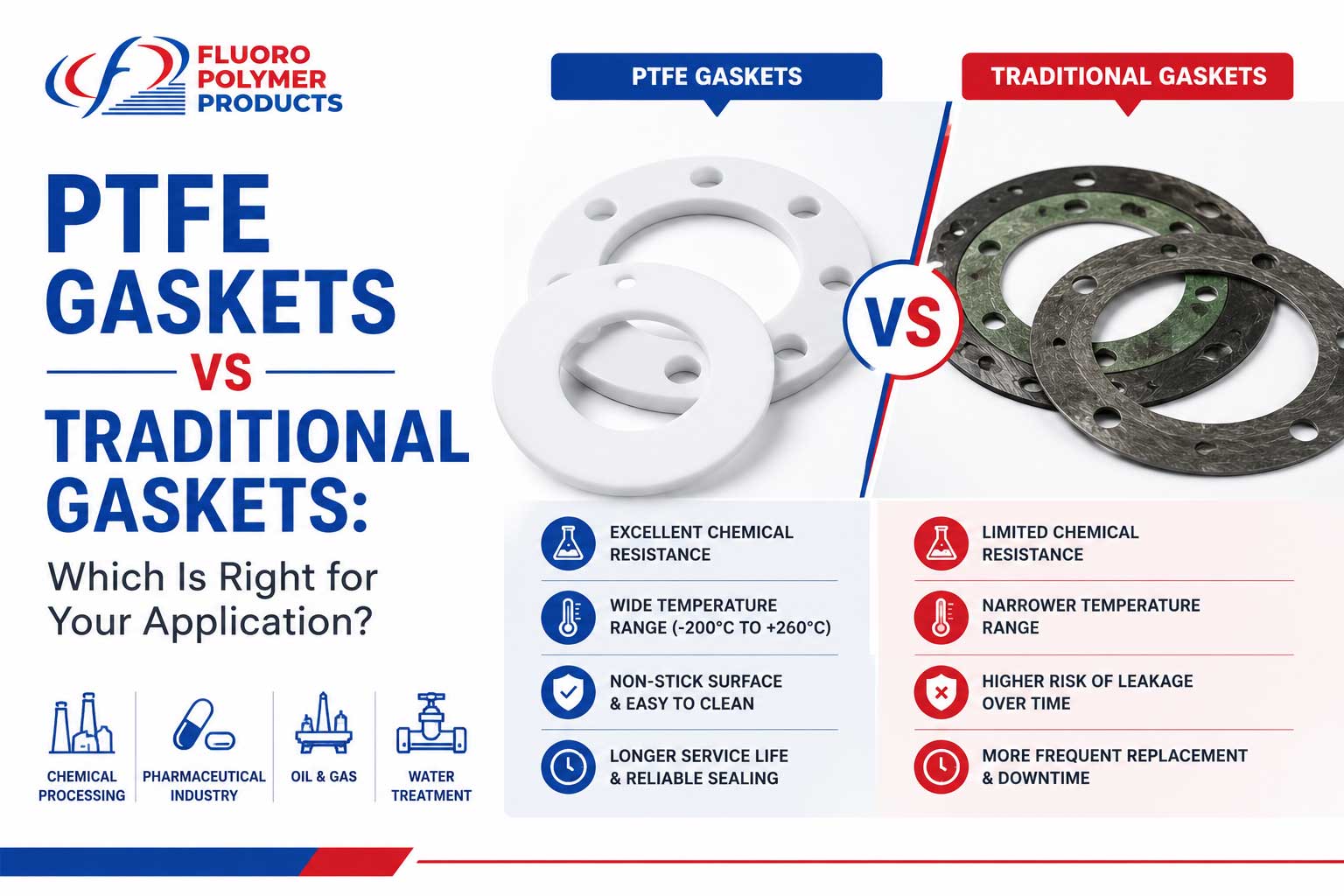
PTFE Gaskets vs Traditional Gaskets — The Complete Engineering Comparison for Chemical & Industrial Applications
In flanged piping systems, heat exchangers, and process vessels across the chemical, pharmaceutical, and oil and gas industries, the gasket is the last line of defence between the process fluid inside the pipe and the personnel and environment outside it. Select the wrong gasket material and you have a potential leak path in a system carrying corrosive acid, toxic solvent, or flammable hydrocarbon. Select the right one and that connection will operate without leakage for years — or decades.
Fluoro Polymer Products, based in Anand, Gujarat, has been manufacturing precision PTFE gaskets — including PTFE ring gaskets, envelope gaskets, sheet gaskets, and custom PTFE seals — for over 30 years, supplying chemical plants, pharmaceutical manufacturers, oil refineries, and power facilities across India and internationally.
Principal Gasket Types in Industrial Use
| Gasket Type | Materials Used | Typical Applications |
|---|---|---|
| Full-face gasket | Rubber, PTFE, soft metal | Low-pressure flanged connections, glass-lined flanges |
| Ring gasket (raised face) | Rubber, PTFE, spiral wound | Medium-to-high pressure process flanges |
| Envelope gasket | PTFE envelope over soft filler | Corrosive chemical service, glass-lined equipment |
| Spiral wound gasket | Metallic + PTFE or graphite filler | High pressure, high temperature, cyclic service |
| Ring joint (RTJ) | Soft iron, stainless steel, alloys | Very high pressure (API pipe flanges, wellheads) |
How the Four Major Gasket Materials Compare
Rubber and Elastomeric Gaskets (EPDM, NBR, Neoprene, Viton): Good conformability and low cost for moderate applications. However, every rubber type has defined chemical resistance boundaries. NBR is degraded by ketones and many acids. EPDM fails with oils and organic solvents. Even Viton fails with certain ketones and steam. All rubber gaskets are susceptible to compression set — permanent deformation under sustained load — leading to eventual bolt load relaxation and leakage. Verdict: Suitable only within specific, tested resistance limits. Not for aggressive chemical service.
Compressed Non-Asbestos Fibre (CNAF) Gaskets: Good general-purpose performance at moderate cost. However, binders and fillers have finite chemical resistance — susceptible to strong acids, oxidising agents, and certain solvents. CNAF gaskets can wick process fluids, creating contamination risk in pharmaceutical and food applications. Verdict: Suitable for moderate-duty general applications. Not for high-purity or aggressive chemical service.
Metallic and Semi-Metallic Gaskets (Spiral Wound, Ring Joint): Excellent at high pressures and temperatures. However, they require high bolt loads and precisely machined flange surfaces — not appropriate for glass-lined, FRP, or other non-metallic flanges. Verdict: Essential at high pressure and temperature. Limited applicability where flange surface capacity is constrained.
PTFE Gaskets: Chemical resistance to virtually every known process chemical — including all mineral acids, alkalis, solvents, and hydrofluoric acid. FDA and USP Class VI compliance. No biological reactivity. Stable from cryogenic to 260°C. Good conformability on glass-lined and FRP flanges. Verdict: The optimal choice for chemical, pharmaceutical, food, and aggressive process applications.
Head-to-Head: PTFE vs Other Gasket Materials
| Factor | Rubber Gasket | CNAF Gasket | Spiral Wound | PTFE Gasket |
|---|---|---|---|---|
| Chemical Resistance | Limited by rubber type | Limited by binders | Limited by metal grade | ✅ Near-universal |
| Temperature Range | Up to ~200°C (Viton) | Up to ~450°C | Very high | -200°C to +260°C |
| Pharma / Food Compliance | Limited | Not generally | Not generally | ✅ FDA / USP Class VI |
| Glass-Lined Flanges | Possible | Not ideal | ❌ Not suitable | ✅ Standard spec |
| HF Acid Service | ❌ Not suitable | ❌ Not suitable | ❌ Not suitable | ✅ Only polymer option |
| Creep Under Load | Compression set risk | Moderate | Minimal (metallic) | Manageable with correct grade |
The PTFE Envelope Gasket — The Engineering Solution for Chemical Service Flanges
A PTFE envelope gasket consists of a precisely machined PTFE outer envelope that fully encapsulates a soft filler material — typically compressed fibre or soft rubber. The result combines the flange conformability of a soft gasket with complete PTFE chemical resistance at all fluid contact surfaces. Even for chemicals that would rapidly degrade the filler material — if the envelope remains intact, the filler sees no chemical exposure. This is the near-universal specification for glass-lined reactor and aggressive chemical service flange connections.
Managing PTFE Creep in Gasket Applications
PTFE's tendency to creep (cold flow) under sustained bolt load is a well-understood and readily managed phenomenon:
• Specify envelope gaskets with rigid fillers or glass-filled PTFE sheet for higher bolt load applications.
• Re-torque bolts after the first heating cycle at operating temperature.
• Ensure correct flange surface finish and bolt stress calculations per ASME guidelines.
• For high-load applications, glass-filled or graphite-filled PTFE provides substantially better creep resistance while retaining chemical resistance.
Fluoro Polymer Products PTFE Gasket Range
• PTFE Ring Gaskets — machined from virgin or filled PTFE to ASME B16.21 and custom dimensions
• PTFE Envelope Gaskets — Flat, Tongue & Groove, Male & Female, Ring styles; glass-lined equipment dimensions available
• PTFE Sheet Gaskets — cut from moulded or skived PTFE sheet in any thickness and custom dimensions
• Custom PTFE Seals — machined to customer drawings, any geometry and grade
Frequently Asked Questions
Q: What is the temperature and pressure limit for PTFE gaskets?
PTFE gaskets are typically rated for -200°C to +200°C and pressures up to Class 150–600 depending on gasket style and dimensions. For Class 900 and above, semi-metallic or metallic gaskets are generally preferred.
Q: How do I prevent PTFE gasket bolt load relaxation?
Specify the correct PTFE gasket type for your bolting configuration — envelope gaskets with rigid fillers or filled PTFE for higher bolt loads. Re-torque bolts after the initial heating cycle. Contact our team for application-specific torque guidance.
Q: Can PTFE gaskets be used with hydrofluoric acid?
Yes. PTFE is one of the very few materials with genuine resistance to HF acid at all concentrations and temperatures within its operating range — making it the only polymer option for HF service.
Q: Are PTFE gaskets suitable for steam service?
Yes, PTFE gaskets perform reliably in steam service within their temperature range. For high-pressure steam (above Class 600), spiral wound gaskets with PTFE filler may be preferred based on specific conditions.