
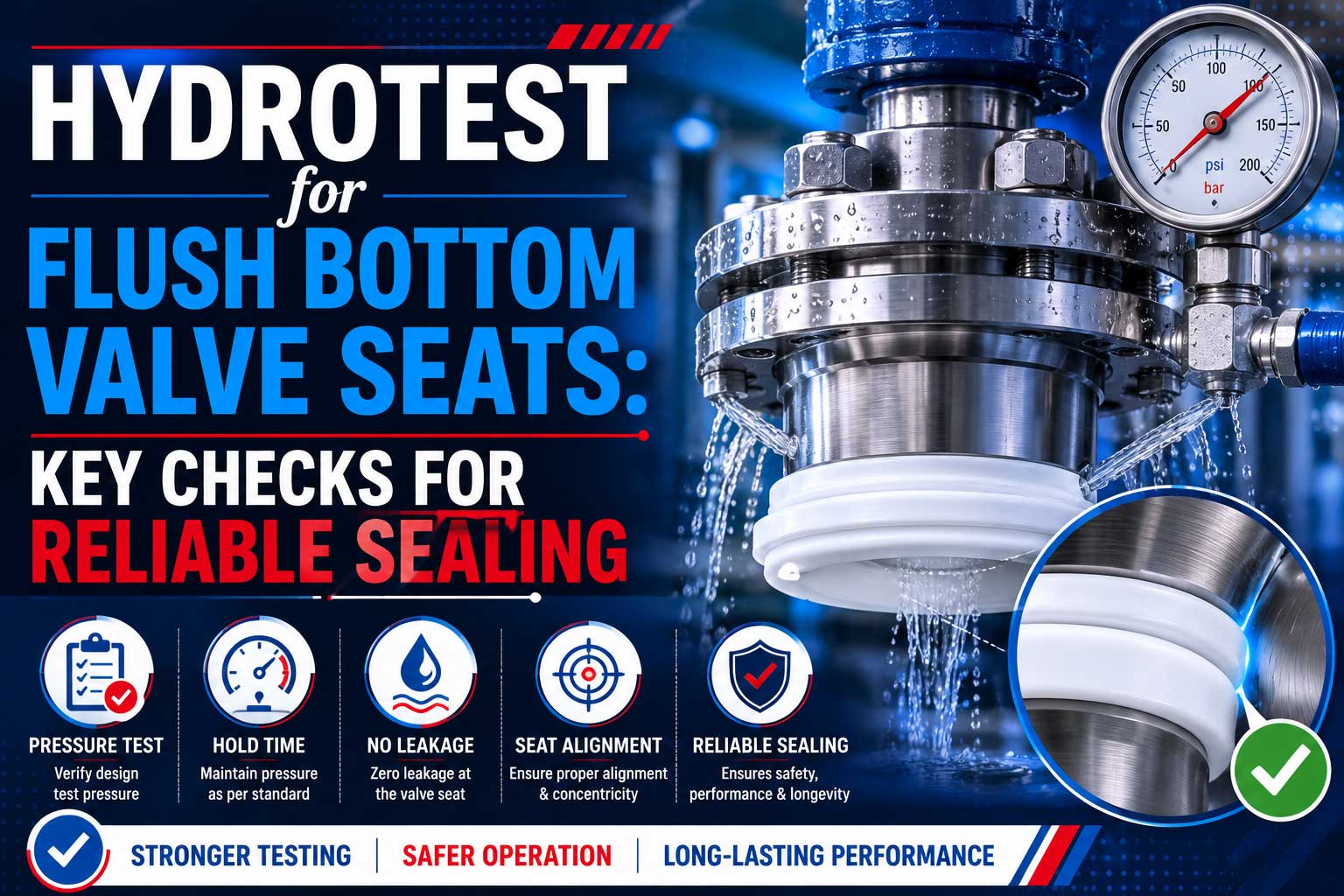
Introduction: Why Hydrotesting Is Critical for Valve Reliability
Flush bottom valves are critical in reactors and process vessels. Failure at the seat can lead to leakage, contamination, production losses, and unplanned shutdowns.
Hydrotesting ensures sealing integrity before commissioning and verifies that the valve assembly can perform safely under operating conditions.
What Is Hydrotesting?
Hydrotesting involves filling the system with water and applying pressure to verify:
- Leak tightness
- Structural integrity
- Seat sealing performance
- Pressure retention capability
Key Hydrotest Parameters for PTFE Valve Seats
| Parameter | Purpose |
|---|---|
| Test Pressure | Verifies valve and seat integrity under pressure |
| Holding Time | Checks sealing performance over time |
| Visual Inspection | Detects leakage or seepage |
| Pressure Monitoring | Identifies pressure loss during testing |
Test Pressure
Typically maintained at 1.3x to 1.5x design pressure depending on applicable standards and operating requirements.
Holding Time
Pressure should be maintained for a defined period to confirm long-term sealing reliability.
Visual Leak Inspection
Inspect for seat leakage, flange seepage, pressure drops, and external moisture formation.
Why PTFE Seats Are Preferred
| PTFE Advantage | Benefit |
|---|---|
| Chemical Inertness | Resists aggressive chemicals and solvents |
| Low Friction | Provides smooth sealing operation |
| Corrosion Resistance | Supports long service life |
| Wear Resistance | Reduces maintenance frequency |
Common Issues Detected During Hydrotesting
- Improper seat compression
- Surface defects
- Misalignment
- Material deformation
- Improper torque application
Hydrotest Inspection Checklist
| Inspection Item | Verification |
|---|---|
| Seat Condition | Inspect for scratches and damage |
| Pressure Stability | Confirm no pressure drop |
| Leak Inspection | Check all sealing interfaces |
| Valve Alignment | Verify proper assembly |
| Material Quality | Confirm PTFE specifications |
Conclusion
Hydrotesting is not just a compliance step—it is a risk mitigation process that validates valve reliability before startup.
Fluoro Polymer Products manufactures PTFE valve seats designed for reliable sealing performance in flush bottom valve applications used across chemical and process industries.
Need High-Performance PTFE Valve Seats?
Contact Fluoro Polymer Products for precision-engineered PTFE valve seats designed for flush bottom valves and glass-lined reactor applications.